Beginnings | Grimethorpe | Early Development | The Research | Desk Research | The National Union of Mineworkers | The National Coal Mining Museum for England | Roadshows | Interviews | Women Against Pit Closures | Auntie June | Pit Women Community Cast | Brass Bands | Storytelling | Mining Through Dance
Beginnings
The beginnings of COAL can be traced back to 2005 when I was working on an autobiographical solo work titled Horsemeat. During that process, I began looking more closely at my past and came to understand how growing up in the working-class coal-mining village of Grimethorpe had shaped me and the way I viewed the world.
I became increasingly interested in the coal-mining industry, the politics surrounding it and the tight-knit working-class communities whose lives had been shaped by it – including my own.
I began some of my early research in the place I knew best: my home village of Grimethorpe.
Grimethorpe
Grimethorpe is a small but resilient little village on the outskirts of Barnsley in South Yorkshire. Built on coal, the village was once home to Grimethorpe Colliery, one of Britain’s deepest coal mines. The pit shaft was sunk in 1893, and generations of men and women who lived and worked in the village developed a proud tradition of hard graft, resilience and community spirit – qualities that remain at the heart of Grimethorpe today.
During the 1984 -1985 British Miners’ Strike, Grimethorpe became a focal point of protest as the village was transformed into a battleground. In the years that followed, the closure of the colliery and other local industries brought profound economic and social hardship.
Unemployment rose above 50% for much of the 1990s, while the 1994 European Study of Deprivation identified Grimethorpe as one of the poorest villages in Europe.
The village has since become widely recognisable as the setting for the acclaimed film Brassed Off, which captured the struggles and spirit of a former mining community. Grimethorpe is also home to the world-famous Grimethorpe Colliery Band, whose success has carried the village’s name far beyond South Yorkshire.
As my research continued, I became increasingly aware that the stories of former coalfields needed to be heard. As a working-class artist, I was conscious of the lack of working-class representation within the arts, and I felt a strong responsibility to help address that absence. The determination to create space for working-class stories became a driving force behind the next development of COAL.
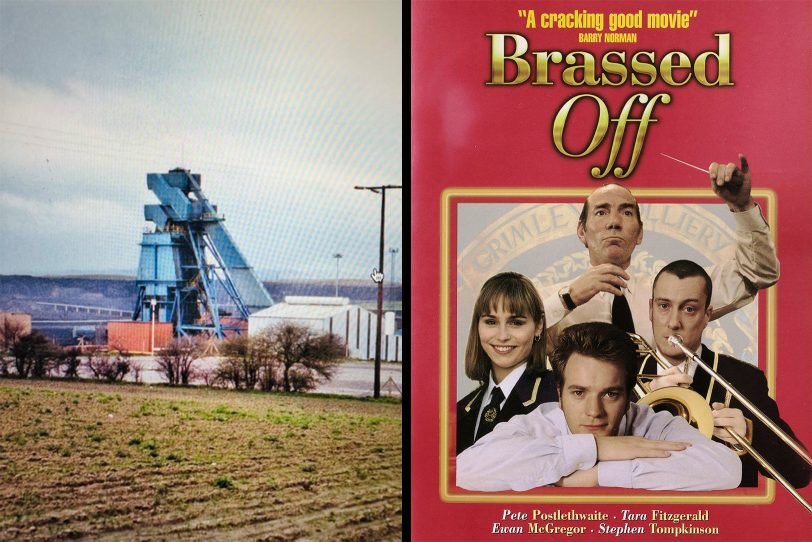
Grimethorpe Colliery | Brassed Off poster
Early Development
In 2007, I created the first 35-minute version of COAL, featuring 4 performers, which was presented as a double bill alongside Horsemeat. Bringing the two works together placed two very different parts of my identity side by side: the experience of growing up gay and the intensely masculine world of an industry renowned for its toughness.
With support from Danceworks UK (Sheffield’s independent organisation dedicated to producing, presenting and promoting dance (co-founded and led by Annabel Dunbar) the double bill toured to The Place in London, The Lamproom Theatre in Barnsley, Yorkshire Dance Centre in Leeds and the Bonnie Bird Theatre at Laban. Following further development, COAL returned to The Place as part of Spring Loaded in 2008.
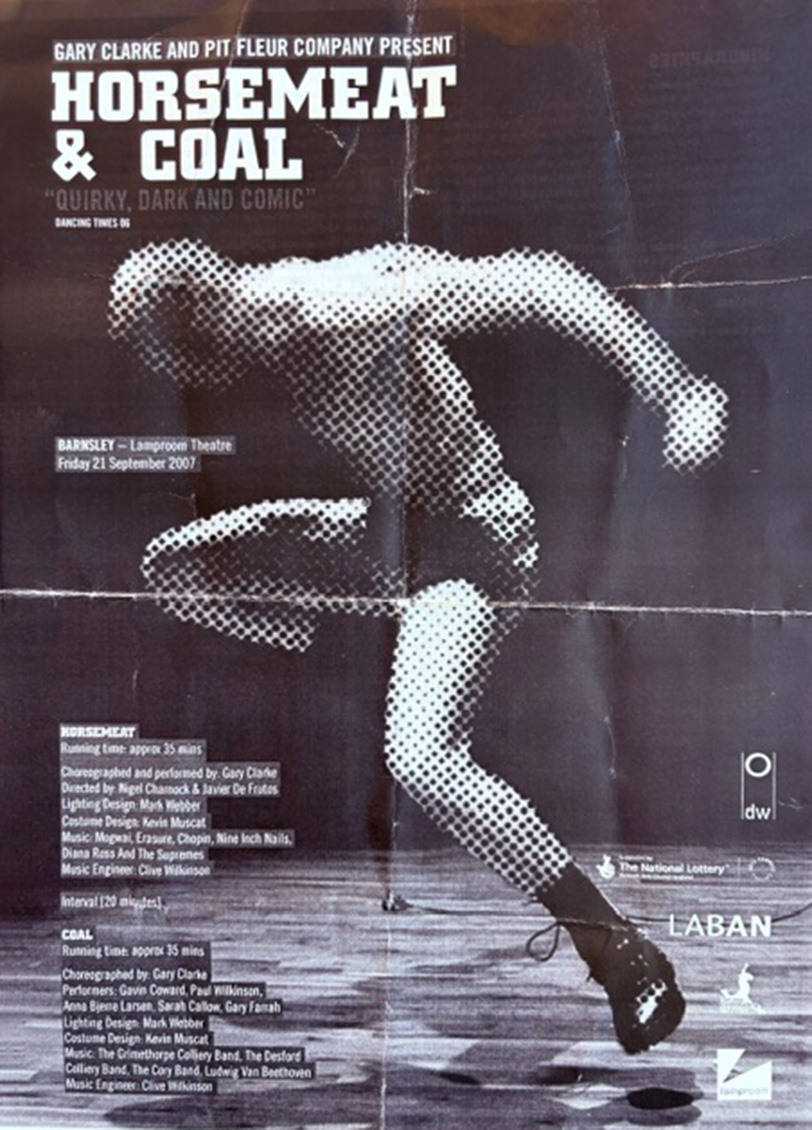
Programme for double bill of Horsemeat and COAL 2007
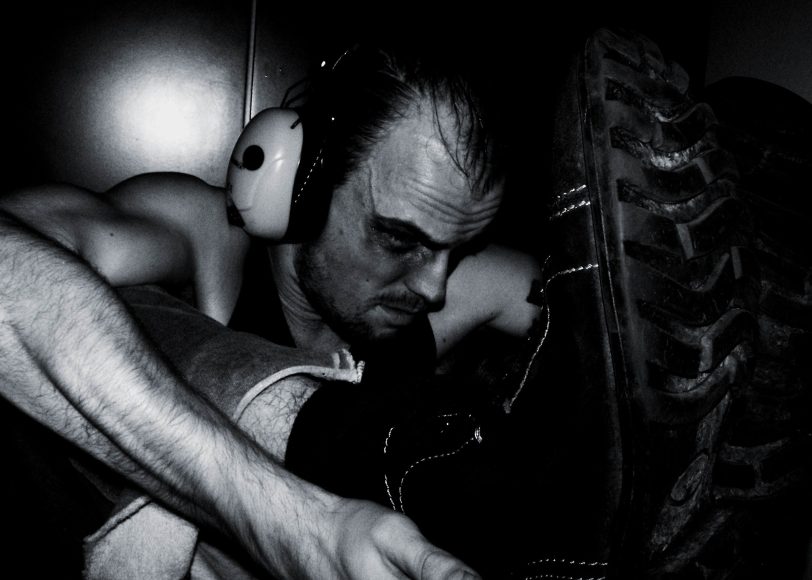
Gavin Coward in early publicity for COAL 2007
The research
Following a 6 year break from COAL, during which I performed and toured with other companies as well as creating new work, long-term collaborator Annabel Dunbar and I decided, in 2014, that it was time to bring COAL back to the stage. Over many bottles of wine and countless cigarettes, we began to imagine a more ambitious, expansive and richly layered production – a full-length work designed for mid-scale touring, both nationally and internationally. This new iteration of COAL would also mark the 30th anniversary of the 1984–85 British Miners’ Strike and we instantly got excited. This was also a departure from small scale touring and into a more advanced arena for making and touring work.
Desk research
I recognised this new version of COAL would require a much deeper level of research. Accuracy mattered enormously and I wanted those who had worked in the industry, lived through the strike or grown up in mining communities to recognise their world in what we had created.
Over an extensive research period and with my then research partner TC Howard, immersed ourselves in a rigorous process, drawing from a wide range of sources including archives, books, journals, media coverage, documentaries, films, podcasts, images and objects. This led on to speaking to people directly from the coalfields and visiting some of the UK’s and leading coal mining institutions.
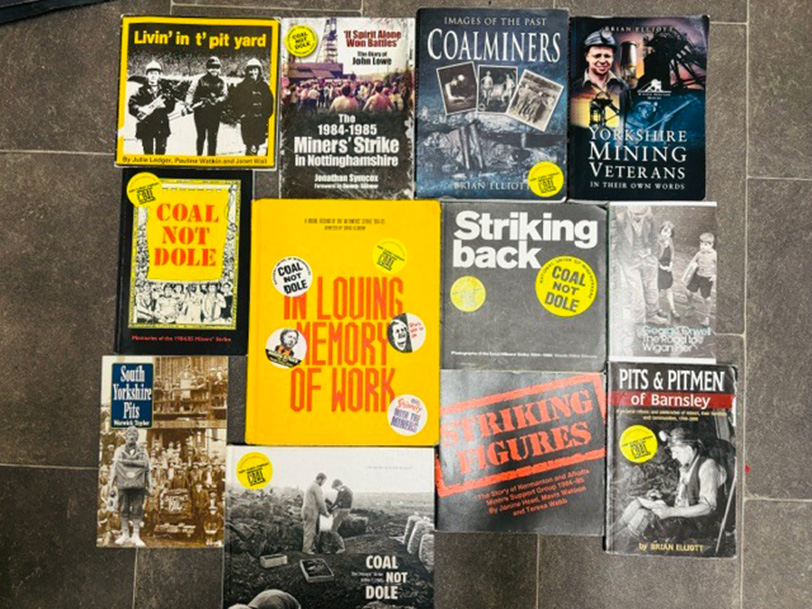
Collection of research materials
The National Union of Mineworkers
One of the key partnerships developed during this research period was with the National Union of Mineworkers (NUM).
The NUM, with its headquarters in Barnsley, is the trade union representing coal workers in Great Britain, formed in 1945 from the Miners’ Federation of Great Britain.
The NUM headquarters is a beautiful and historic building, home to a wealth of archive material, including books, photographs, newspaper cuttings, documentaries, films, historic mining banners and other fascinating records of the industry and its communities. We spent hours delving deep into this rich archive, uncovering new material and insights that helped to further inform the development of COAL.
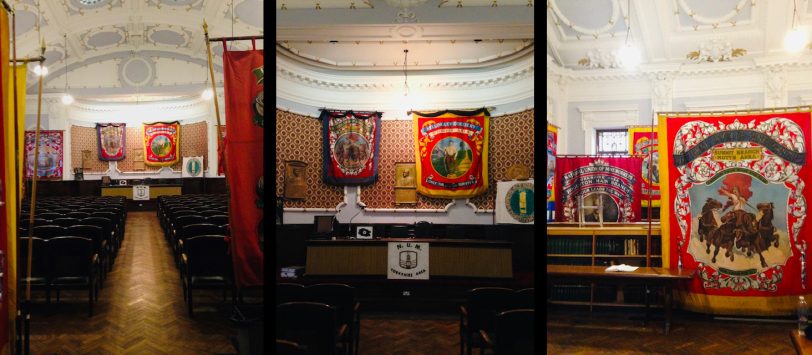
The National Union of Mineworkers (NUM)
The National Coal Mining Museum for England
Our partnership with the National Coal Mining Museum for England opened up another huge area of research.
Based at Caphouse Colliery in Wakefield, the National Coal Mining Museum for England preserves and shares the history of coal mining through its extensive collections, archives, exhibitions and historic colliery site. The museum also hosts one of the UK’s few underground mine tours.
As well as immersing ourselves in the museum’s many collections and exhibitions, the company dancers and I were invited to descend 140 metres underground, accompanied by a former miner, to experience first-hand something of life at the coal face – the confined spaces, the smells, the heat, the noise and humidity, the equipment, and the intense physical environment in which miners had worked.
The visit took us through almost 180 years of mining history, but for us it also became a profoundly physical experience. It was during this tour that we began to really understand something of what it meant for the body to work within such a confined and demanding environment. This experience directly informed the physical and choreographic language of Act 2 of COAL. See Coal Mining Through Dance
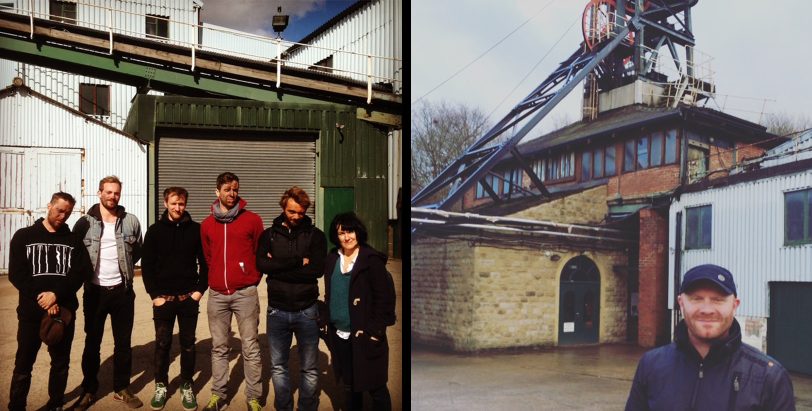
COAL dancers and Gary Clarke at NCMME
Roadshows
Speaking with people directly made the research come alive. Conversations with a wide range of people allowed us to ask honest, targeted questions and hear powerful stories first-hand.
We organised a collection of Roadshows, inviting former miners to attend to share their experiences of life in the coalfields.
Roadshows were held at a Working Men’s Club in Edlington, the NUM in Barnsley and at Grimethorpe Working Men’s Club.
People were incredibly generous and eager to talk. They arrived carrying photographs, newspaper cuttings and treasured objects, but most importantly, they brought their memories.
The stories were emotional, insightful and often very raw. People talked about the strike and the deep sense of injustice that remained decades later. There were scars that had never completely healed.
But the stories were not limited to 1984 and 1985. Former miners spoke about the realities of working underground – the danger, the physical labour, the camaraderie and the humour.
They talked about everyday life in mining communities and the culture that existed around the pits before the industry disappeared.
As coal mining vanished, there was a strong feeling that work such as COAL was becoming increasingly important. It was not only about remembering the strike; it was about making sure that the wider history, culture and lived experiences of these communities were not lost with it.
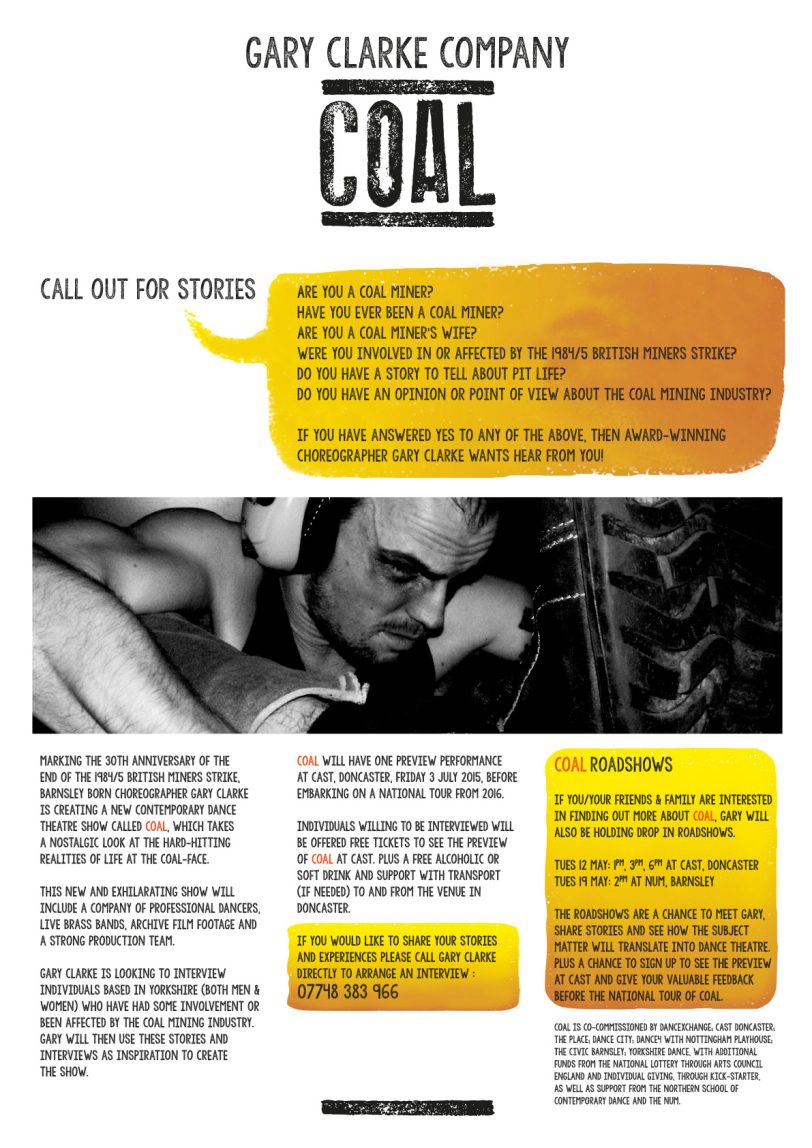
Roadshow call out for stories
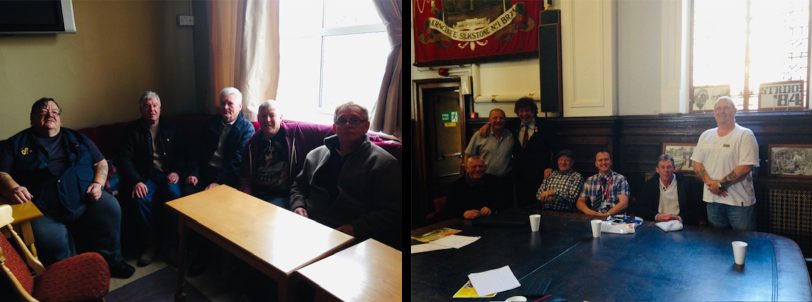
COAL Roadshow at the NUM
Interviews
Alongside the Roadshows, we also carried out a series of more focused individual interviews with people whose particular knowledge, experiences and perspectives could deepen and enrich the research.
These included:
- Frank Arrowsmith – Former Yorkshire Main miner and Edlington Mayor
- Brian Elliott – Author and mining historian
- Paul Winter – Orgreave Truth and Justice Campaign
- Bruce Wilson – Former Silverwood Colliery miner, author and ‘flying picket’
- Craig Oldham – Designer, writer and creator of ‘In Loving Memory of Work’
- Chris Skidmore – Chairman of the NUM
- Pete Yoxhall – Former Grimethorpe Colliery miner
Women Against Pit Closures
One of the biggest shifts in our understanding came through researching the women of the coalfields.
Coal mining itself was overwhelmingly male, and much of the history I had initially encountered was told through men. But the miners’ strike could not be understood without acknowledging the women who organised, fundraised, fed families, ran support groups, marched, campaigned and stood on picket lines.
We had the amazing opportunity to spend time with famous campaigners Anne Scargill and Betty Cook, both prominent activists and co-founders of Women Against Pit Closures. Their testimonies gave us an essential perspective on the strike. While much of the historical narrative had focused on miners, pits and picket lines, Anne and Betty spoke about the extraordinary network of women who mobilised across coalfield communities.
They organised food, raised money, supported families, travelled the country, marched and campaigned. They were not standing at the edge of the dispute; they were an integral part of it.
Through our conversations, Anne and Betty introduced us to Triona Holden’s book Queen Coal: Women of the Miners’ Strike, which records the experiences of women from mining families during and after the dispute.
Anne and Betty spoke specifically about ‘The Women’s Song’ (The Women of the Working Class) and told us that we must include it in COAL. They felt strongly that, if we were going to represent the women’s experience accurately, the song needed to be heard on stage.
For them, it was more than simply a song. It carried the politics, solidarity and collective identity of the women who had organised and mobilised throughout the strike. Including the song in COAL became an important way of giving those women a voice within the work.
A Documentary on Women Against Pit Closures can be found in the Resources section
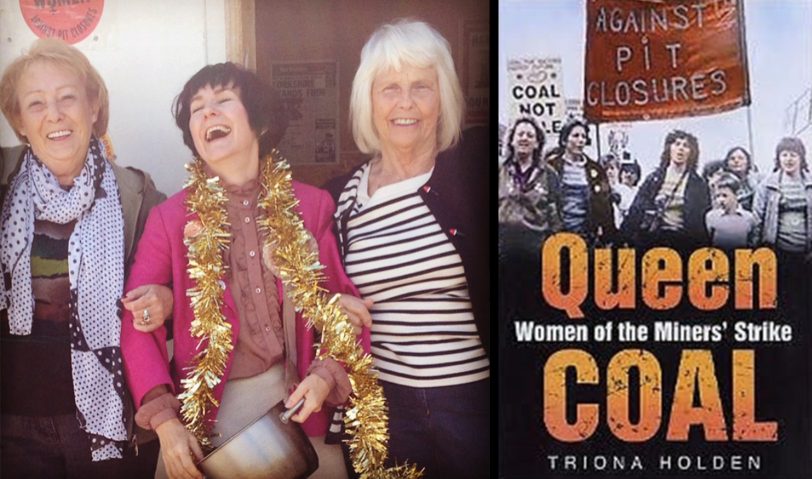
Researcher TC Howard with Anne Scargill and Betty Cook | Queen Coal by Triona Holden
Auntie June
The research with Anne and Betty gave us the story of women organising publicly and politically, but we also wanted to understand the work taking place behind closed doors.
One of the most profound moments in the research came when we interviewed my Dad’s sister, Auntie June. She was one of seven children and later married Uncle Pete, who worked as a coal miner at Grimethorpe Colliery for most of his life.
Over several hours, and with plenty of tea and biscuits, she gave us a rich and detailed insight into the everyday life of a woman in the coalfields. While Anne and Betty had spoken about women’s activism on the front line, Auntie June described the equally demanding struggle taking place inside the home.
She talked about feeding hungry mouths, raising a large family, keeping on top of the domestic chores and dragging Uncle Pete out of bed when he didn’t want to go to work.
During the strike, she worked 3 jobs to help keep the family going.
Her stories revealed the domestic reality of the period and what it took to run and hold together a miner’s home before, during and after the bitter, year-long dispute.
Auntie June helped us understand that the story of the coalfields was not only about the men underground or the women on the picket lines; it was also about the often-unseen labour that sustained the families and the communities.
Together with Anne and Betty, the stories showed us the many different forms women’s strength took across the coalfields which led directly to one of the most distinctive parts of COAL – The Pit Women.
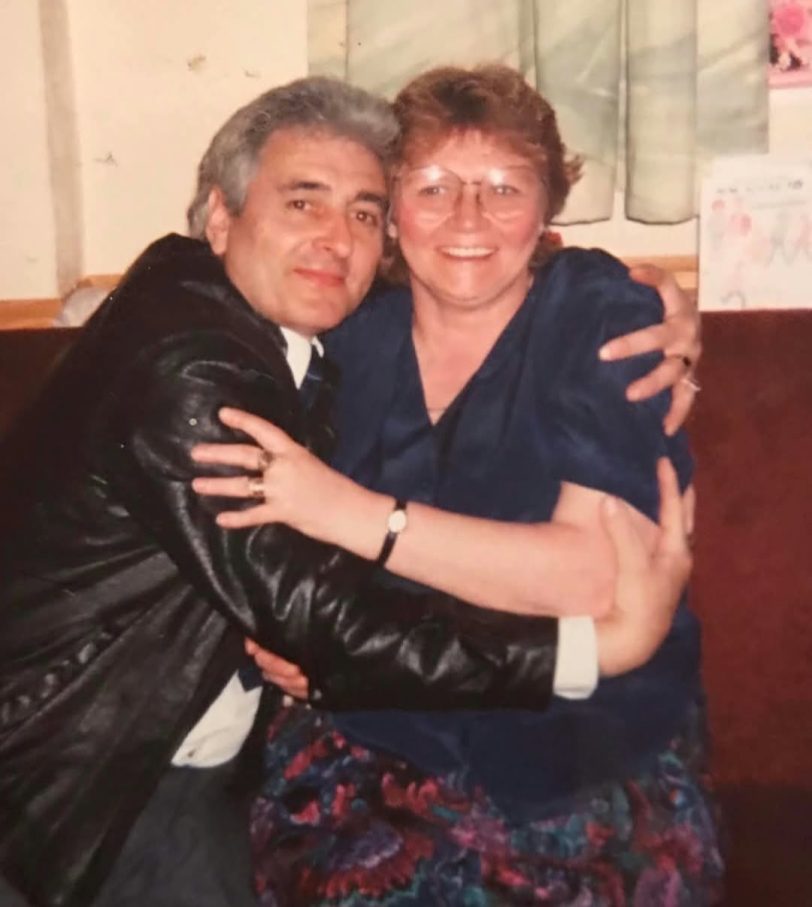
Gary Clarke’s Auntie June and Uncle Pete
Pit Women Community Cast
With 5 male dancers already portraying the miners and dominating COAL, I began to wonder what it might mean to bring local women with a connection to mining directly into the production. Most of these women might have never performed before but their presence could bring a sense of lived experience and a startling authenticity that professional performers, however skilled, could not create on their own.
TC Howard was already taking on the role of a ‘miner’s wife’, but we felt that women needed to be present in the work in a much more collective way – not simply as individual characters, but as a community and a visible part of the mining story.
We put out a call looking for women aged 30 and over from local coalfield communities and arranged an introductory session at CAST in Doncaster. We set out 100 cups for tea and coffee and waited expectantly for the arrival of the women.
But nobody came.
As the minutes passed, our excitement began to fade, and with it, the ambition of bringing local women into COAL. Eventually, and somewhat reluctantly, we began packing away the untouched refreshments.
Then, just as we were giving up hope, a small but stocky white-haired man walked through the door with an air of confidence. He looked around and asked, “Is this where the coal thing is?”
It was not quite the arrival we had been expecting.
He sat with us for the best part of an hour, telling us stories about his life and his connection to the mining industry. Just as he was about to leave, he paused and said, almost as an afterthought, “Oh, and by the way, I can get you some women.”
We later discovered that this was Frank Arrowsmith, a former coal miner of Yorkshire Main, former Mayor of Edlington and a nationally recognised authority on mining heritage. At the time, we had no idea quite how significant that chance encounter would become.
A few days later, 3 of Frank’s family – Kelly, Emma and Kim, arrived at our rehearsals, along with Sarah from Barnsley. None of them had ever performed on stage before, yet they became the first-ever group of our COAL Pit Women.
These 4 women helped us shape what the Pit Women could become. They were not simply cast members; they became part of the creative process, helping us discover the voices, relationships and physical language of the Pit Women. They created the blueprint for every community cast on tour that followed.
They performed our first preview of COAL at CAST theatre in Doncaster to an audience of more than 200 guests including their friends and family and of course – Frank. As the curtain came down to riotous applause, they were overwhelmed by what they had achieved. They had not only stepped onto a stage for the first time but had done so carrying the story of their own local mining community with them, and, in doing so, had made their community proud.
For these women, it was an experience that has stayed with them. What had begun as an invitation to try something new had become something much more profound: a sense of belonging, pride and ownership. It was, quite simply, life-changing.
““It was exciting, exhilarating and emotionally rewarding...the team could not have been more welcoming... we were in it together. The bond we developed with the professionals was beautiful... COAL has changed my entire interpretation of theatre.” ”
At each venue on the tour, we recruited a new group of local Pit Women, bringing different ages, backgrounds and experiences into the production. By the end of the 2016–2018 tour, 90 women from across Britain had performed as Pit Women. This model not only celebrated and brought together women within their local communities, but also created a national community connected by a shared experience.
This community cast model developed through COAL went on to influence later our (Gary Clarke Company) productions including WASTELAND and DETENTION. It showed us that community participants could do far more than accompany a professional on stage. They could shape the production’s identity and become fundamental to the stories being told.
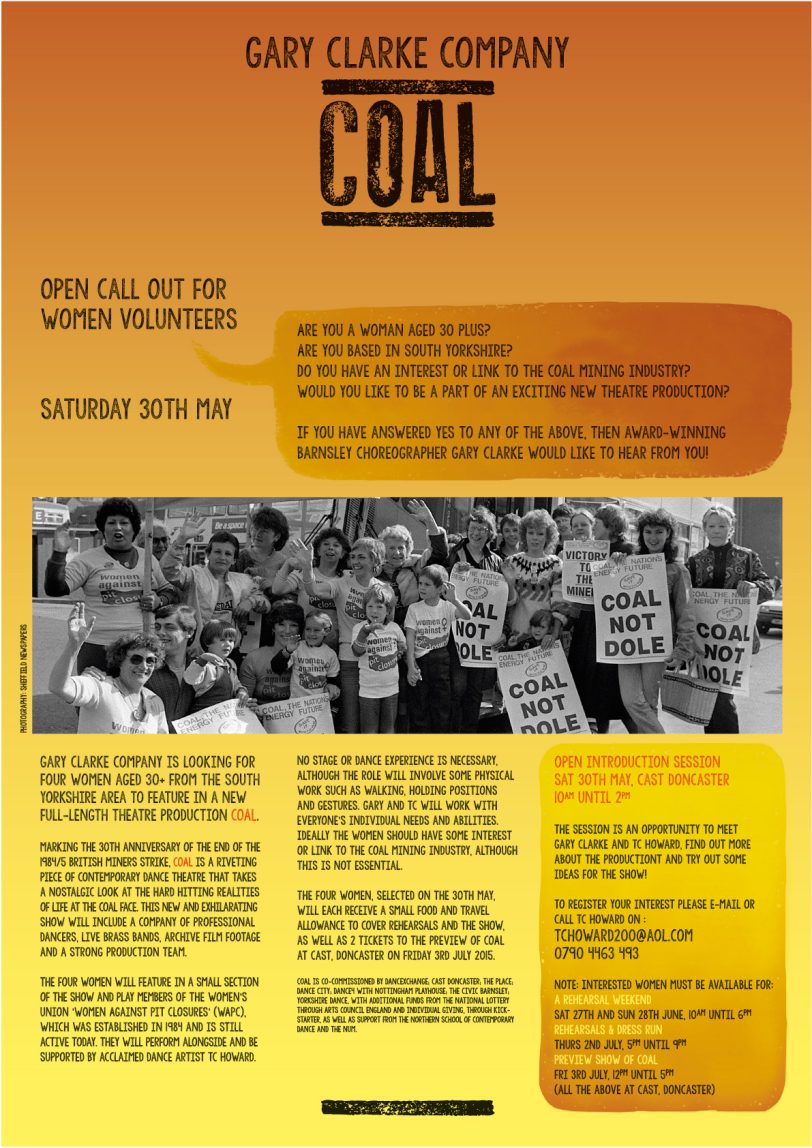
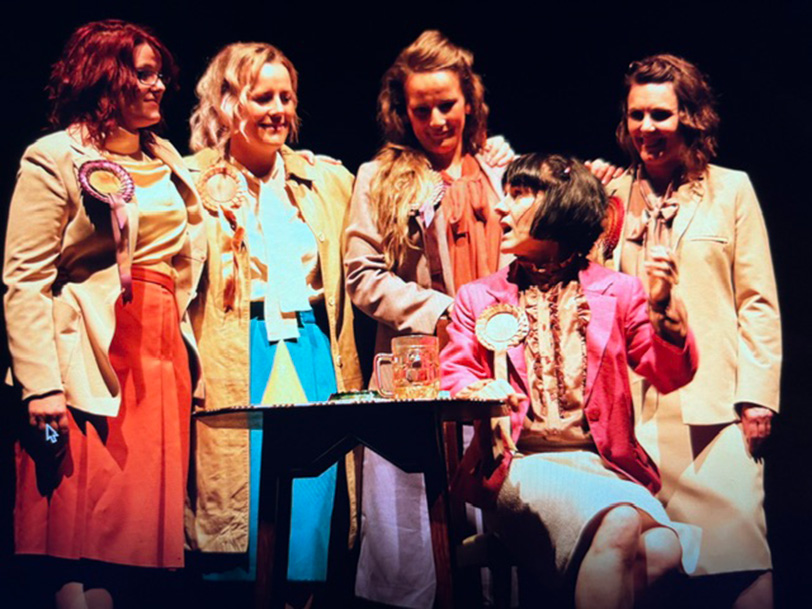
TC Howard with Pit Women Kelly, Kim, Emma and Sarah in COAL
Brass Bands
There was another part of coalfield culture that I knew we could not ignore.
Brass bands.
Growing up in Grimethorpe, the sound of brass was part of our daily lives and the world around us. The Grimethorpe Colliery Band went on to become one of the best-known brass bands in the world. But Grimethorpe was not unique. Mining communities across Britain had their own bands, many with histories stretching back into the nineteenth century. For me, brass was part of the sound of the coalfields and I could not imagine making this new version of COAL without it.
I had wanted to integrate live brass into earlier versions of COAL, but limited funding and resources made this impossible. This newer, more developed version of COAL would finally allow me to fulfil that ambition, bringing live music into the show and giving the piece a deeper sense of authenticity and relevance.
The beauty and power of live brass within a contemporary dance production also felt like new territory. Working with Musical Director Steven Roberts, we began exploring how live brass could be fully integrated into the production also acting as a character in its own right rather than simply sitting behind the dancers as a recorded soundtrack as it had in the earlier versions.
A relationship developed with Carlton Main Frickley Colliery Band, based in South Elmsall and founded in 1884. We visited them in their band room and heard them play as they prepared for the regional championships. The connection felt immediate and personal. They had a great sound and I knew we needed to collaborate.
Together, we began to imagine what a live score might sound like, written for a five-piece ensemble and drawing on the traditions of brass band music including marches and hymns. We settled on four set pieces, and the live brass element was born. Carlton Main Frickley became our resident band and we continue our relationship today.
Like our original Pit Women, Carlton Main Frickley became the blueprint for what was to follow.
We wanted to work with championship brass bands across the country that were unique to each area. It was important that COAL connected with the places it visited. Each mining community had its own history, identity and musical traditions, and bringing those into COAL became another way of making the work locally specific and richer on tour.
Between 2016 and 2018, we collaborated with 18 championship brass bands from around the country, integrating 145 brass players into the work. Bands included Tredegar Town Band, The Brighouse & Rastrick Band, Whitburn Band and Thoresby Colliery Band. For many, it was their first experience of performing for live theatre or contemporary dance.
The brass bands became another marker of authenticity, helping us to uphold COAL’s mission to remain true to its subject while allowing each new community to leave its own mark on the work.
Each band brought something different. The music belonged to COAL, but the sound was unique and rooted in the community in which we were performing. This gave every performance its own character and sense of place.
“It felt like we were representing brass / mining culture from a local perspective within an exciting art form which is totally different from our normal experience.”
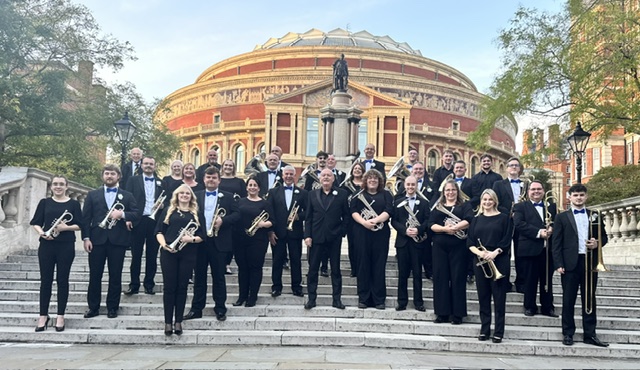
Carlton Main Frickley Colliery Band
Storytelling
I knew that, for COAL to succeed in its intention, it needed to be accessible, factual and clear. I wanted former miners and their families to come and see it. Many of the people whose history we were representing on stage had possibly never seen a contemporary dance performance before, and many may rarely have been inside a theatre at all.
If we wanted those audiences to engage with COAL, the way in which the production spoke to them had to be clear. That did not mean simplifying the history; it meant treating the people and their stories with respect.
As a working-class artist, I felt a responsibility to hold that history in high regard and to approach it with sensitivity and accuracy. I could never imagine making COAL as something deliberately abstract or disconnected from the experiences we had spent so long researching. The research had to remain clear and visible within the work.
That commitment became the foundation on which the production was built. It shaped the structure, the visual world, the sound, the costumes and the choreography. Every element had to come together to tell one shared story of struggle, resilience and a proud community.
Mining Through Dance
At the centre of COAL was still a choreographic question: How do you represent the true nature and back-breaking work of coal mining through dance? The aim was for an audience to feel something of the hard labour and harsh reality of life underground – to feel as though they were watching miners mining rather than dancers dancing. It was no mean feat, and we experimented with many different approaches. We had to find a movement language that could carry the weight, repetition, danger, exhaustion and resilience of the pit.
We began by looking closely at footage of miners at work, both historically and in more recent years. We drew parallels between the physical labour of working underground and the physical labour of movement. Mining in the early nineteenth century was intensely physical, with miners cutting coal with a pickaxe and relying on their own physical exertion to extract it. In more modern times, machinery increasingly took over this work. I became interested in the relationship between the human body and machinery: how man and machine can become one, and how the boundaries between the two begin to blur.
This metaphor became an important starting point for the choreographic language. We explored relentless rhythm and repetition: the rhythm of machinery, the repetition of physical labour and the many actions involved in extracting coal. The movement had to feel erratic and unpredictable, mirroring the working environment underground. We would build sequences of movement that might begin and then suddenly be disrupted. Movement could stop abruptly, change direction or break apart.
The quality of the movement mattered just as much. The dancers could not appear to be moving freely through an empty stage. We worked with the idea that the space around the movement was dense and that moving through it should feel difficult. We wanted to witness the bodies in constant effort – the exact opposite of what we are often told a dancer should be.
Through this qualitative layer, the dancers pushed, pulled, lifted and dragged, working against the space around them and creating a sense of genuine physical fatigue within the body. The movement was not simply about representing the actions of mining; it was about making the physical cost of that labour visible. The dancers had to carry the weight of the work in their bodies, allowing the audience to see, and hopefully feel, the exhaustion, strain and resilience that defined life in the pit.
For the choreography to feel real, I knew it could not simply exist on its own within the space; it had to be seen alongside recognisable, ‘real’ actions. Coal, wood, pallets, wires, buckets, water, chalk, shovels and smoke were introduced into the space, creating a busy and sometimes dangerous environment in which to dance. When the dancers were not performing the choreography, they would have to navigate the busy space and occupy themselves with numerous practical work tasks such as building tunnels, shovelling coal and transferring water. These everyday actions provided a physical and visual counterpoint to the choreographic language. Placing highly stylised movement alongside recognisable acts of labour created a world that felt both realistic and heightened – a hyper-stylised version of life underground. The two languages could exist simultaneously, allowing the audience to move between witnessing the reality of the work and experiencing an amplified physical expression of it.
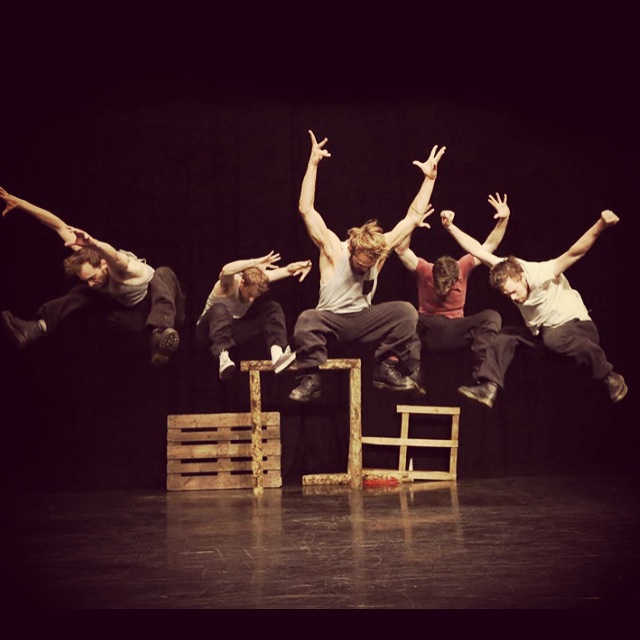
COAL dancers in rehearsals